Skip to Content

WoW Insider is getting ready for BlizzCon!
AOL Tech

laser posts

Sonic 'laser' developed, makes quite an impression at 80s night


A researcher from the University of Nottingham and his Ukrainian colleague have built the world's first Saser: a device that generates a highly concentrated beam of sound waves at terahertz frequency. Not unlike the frenetic warblings of Welsh chanteuse Bonnie Tyler, when alternating layers of aluminum arsenide and gallium arsenide are exposed to an intense beam of light, photons are released, causing them to bounce back and forth between the layers. Eventually the sound waves combine into much stronger, highly concentrated sounds in which every particle is synchronized -- creating an ultra-high frequency "phonon" beam. Although practical applications for this technology have yet to be developed, it is hoped that Sasers could someday be used to probe and manipulate electronic devices at the nanoscale level, with results that include terahertz-frequency processors which would make the "computers of the future" a thousand times faster. Video after the break.

[Via Gizmag]

Spintronics magic appears again, aims to vastly accelerate data storage and retrieval


As the list of "awesome things that won't ever happen" grows ever longer, we've got a brilliant team of French physicists who have seemingly concocted a method for storing and retrieving data on hard discs that's around 100,000 times faster than usual. Yes, 100,000x. The trick is based around spintronics, an almost mythical procedure that involves the use of lasers, magnetic sensors and mutant abilities to shuffle data around at a dizzying rate. This particular method, however, improves upon the comparatively sluggish attempts of the past, as it uses photons that "modify the state of the electrons' magnetization on the storage surface." In layman's terms, this all means that the HDD you buy in 2098 will probably operate significantly faster than the one you picked up during Circuit City's going-out-of-business sale. Got it? Good.

Ultra-powerful laser could make incandescent light bulbs more efficient


Look, LED light bulbs are fanciful, great for Ma Earth and a fine addition to any home, barber shop or underground fight club. But let's be honest -- even the guy that bikes through blizzards to get to work and wears garb that he grew in his basement isn't apt to shell out $120 a pop to have what's likely the most efficient light bulb American dollars can buy. Enter Chunlei Guo from the University of Rochester, who has helped discover a process which could morph a traditional incandescent light bulb into a beacon of burning light without using nearly as much energy as before. In fact, his usage of the femtosecond laser pulse -- which creates a "unique array of nano- and micro-scale structures on the surface of a regular tungsten filament" -- could enable a bulb to increase output efficiency in order to emit 100-watts worth of light while sucking down less than 60-watts of power. Per usual, there's no telling when this new hotness is likely to hit the commercial realm, but one's thing for sure: we bet GE's paying attention.

[Via Physorg]

World's largest laser opens for business in California

Another day, another laser... well, not so fast. This particular laser just so happens to officially carry the "world's largest title." Built at Lawrence Livermore National Laboratory in Livermore, California, and housed in the National Ignition Facility -- or NIF -- it was completed at the end of March, and has just now been officially dedicated and opened for business. The laser inside the three-football field-sized building will aim to create a "star" on earth by focusing 192 beams at a pea-sized target, generating temperatures over 100 million degrees and pressure over 100 billion times the earth's atmosphere. The process will create nuclear fusion -- the reaction that powers the sun and the stars. it sounds pretty complicated, and we'd hate to be in town if something goes awry, but we're crossing our fingers for the team! Hit the read link for much, much more information about the project.

[Via Physorg]

Laser Energetics' new light weapon puts you on the highway to the Dazer Zone


Are you looking to torment a neighbor / random passerby without the messy after-effects of traditional "just plain lethal" weapons? Perhaps you work for a law enforcement agency and you'd like to justify a budget increase by pouring cash into something vaguely futuristic. Or maybe you're a big city mayor with a "tough on crime" stance who'd rather not put any more money in social services. If so, we've found something both painful and cute sounding to add to your shopping list: Laser Energetics ("the total laser technology solutions company!") has just unveiled its new Dazer Laser less-than-lethal light fighting technology line. These bad boys operate at a range of up to 2400 meters (depending on the model), and work by emitting a green laser beam that fans out into a 1 x 8-foot "Dazer Zone." When focused on a person's eyes, his or her vision is temporarily impaired, their balance is effected, and they become overwhelmed by nausea. At the very least, this sounds much better than being microwaved, right?

[Via Test Freaks]

Laser Matrix instructions will help you make an incredibly facile projector of your iPhone


A clever DIY-er wanted to add some semblance of projector capability to his iPhone, without -- you know -- actually adding a projector to his phone. He chose instead to use the phone in tandem with a 5 x 7 laser matrix, five 8-bit D latches for controlling the laser pointers, a microcontroller, and a bit of (somewhat complex looking) code for the iPhone, resulting in the ability to "spell" out messages on a wall, or other surface. There's a super exciting video demo after the break -- check it o-u-t.

Nanocrystal breakthrough promises more versatile lasers, world peace


For the longest while, scientists have been flummoxed by the incessant coruscating emitted by individual molecules; no matter their methods, they could never quite seem to overcome a troubling optical quirk known sensibly as "blinking." Thanks to a brilliant crew at the University of Rochester, however, we now understand the basic physics behind the phenomenon, and together with a team from Eastman Kodak, a nanocrystal has been created that can constantly emit light. In theory, the discovery could lead to "dramatically less expensive and more versatile lasers, brighter LED lighting, and biological markers that track how a drug interacts with a cell at a level never before possible." Indeed, one could envision that future displays could be crafted by painting a grid of differently sized nanocrystals onto a flat surface, making even OLED TVs look chubby in comparison. Now, if only we had a good feeling that such a device was destined for a CES in our lifetime...

Boeing's Airborne Laser begins flight tests, future uncertain


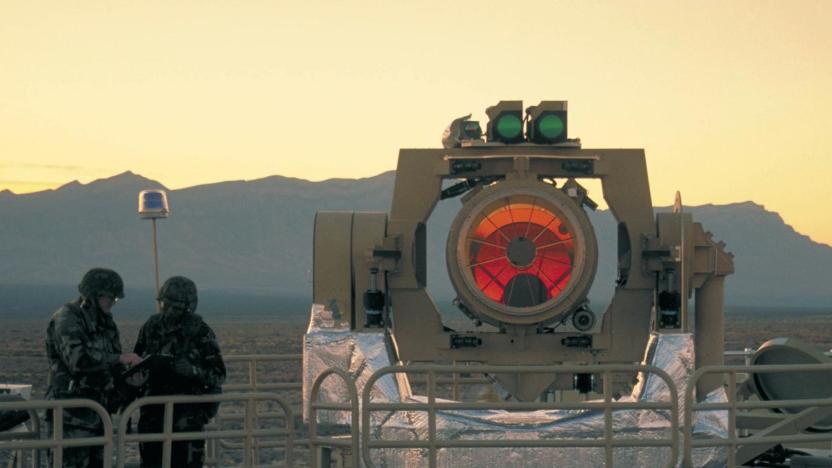
Boeing was pretty bullish about its aircraft-mounted laser system only a few short months ago, but it looks the program's future is now considerably more uncertain, even as the sole aircraft to be equipped with the rig begins its first flight tests. Apparently, everything with the tests themselves has been going according to plan, with both the high-energy laser itself and the "beam control / fire control apparatus" along for the ride, and Boeing is even reportedly still on track for a missile-intercept demonstration later this year. The recent funding shakeup at the Pentagon, however, has thrown Boeing and its partners in the project for a bit of a loop, with the department now apparently intending to keep only one of the planes in service (instead of the proposed seven) as it transitions the rest of the program towards a purely R&D effort.

Navy shells out for development of missile-killing free-electron laser


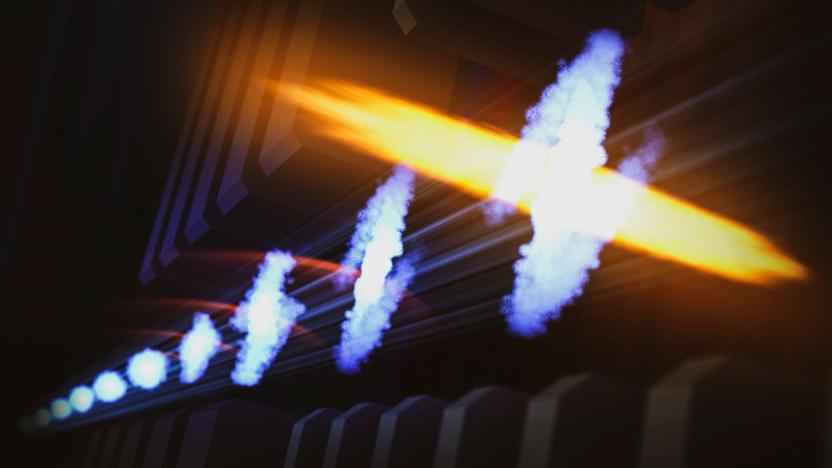
You may think that the Navy's just the baby brother to the two other US Armed Forces, but its weapon development record definitely shows otherwise. Just over two years after building an 8-Megajoule railgun, the branch has penned two $7 million checks to defense contractors Boeing and Raytheon for the design and development of a free-electron laser (FEL). For what it's worth, such a device has been yearned for since a day after the dawn of time, as unlike chemical-based lasers, the FEL would be 100 percent electric and easier to move. For those unaware,this stormy petrel of a weapon would be used to blast down missiles in mid-flight, all while putting on a pretty impressive light show. 'Course, the Navy must also figure out how to build a massive energy generating ship in order to use it, but let's not get too far ahead of ourselves here, okay?

[Image courtesy of AIP]

Army's multimode death ray knocks out IEDs, vehicles, whiners


While the US Air Force is dead set on shooting down missiles with airborne lasers, it looks like their colleagues in the Army are busy cooking up a little something called the Multimode Directed Energy Armament System (see our artist's conceptual rendering, above). According to Wired, this device uses an ultra-short pulse laser to create an ionized channel through the air, which it can use to send bursts of energy, conduct electricity, or act as a waveguide for an intense pulse of microwaves. If you're looking to knock out an IED, an oncoming vehicle, or an enemy combatant, this bad boy should do the trick just fine. The Army's Armament Research Development and Engineering Center (ARDEC) plans on having a working prototype operating in a the real world sometime in 2011.

[Via Wired]

Liquid crystal lasers will light up next-gen HDTVs, your life

Liquid crystal lasers will light up next-gen HDTVs, your life
If you thought Mitsubishi's LaserVue HDTVs were the beginning and the end of laser-tech in boob tubes, think again. Mitsu's line is carrying on, but the brightness and depth of color offered by that telly are apparently just the beginning of what's possible according to researchers at the Centre of Molecular Materials for Photonics and Electronics at the University of Cambridge. They indicate that the use of liquid crystals in concert with a single, laser-based light source would result in the same color depth but at a lower cost and higher reliability than the LaserVue, which requires separate lasers for RGB. What cost, exactly? That, dear reader, remains to be seen, but given the source we're thinking you have plenty of time to save up -- and to practice those Dr. Evil impressions.

[Via OLED-Display]

New atomic clock claims title of world's most accurate


You may have thought that the previous world's most accurate clock was good at keeping time, but it's apparently nothing compared to this new strontium atomic clock developed by scientists at the University of Colorado, which is supposedly more than twice as accurate and just as atomic. To achieve that impressive feat, the scientists made use of the same so-called "pendulum effect" of atoms as before, but took things one step further by holding the atoms in a laser beam and freezing them to almost -273 degrees Celsius, or the temperature at which all matter stops resonating. In clock terms, that translates to about one second lost every 300 million years. Of course, that's still one second too many for the researchers, and they say they "dream of getting an atomic clock with perfect precision." You just know you never want to be late for a meeting with these guys.

Simple keystroke sniffing schemes work where keyloggers won't


Ah, the wonders of CanSecWest. The famed security conference has delivered yet again in 2009, this time bringing to light two simple sniffing schemes that could be used to decipher typed text when keyloggers are just too noticeable. Gurus from Inverse Path were on hand to explain the approaches, one of which involved around $80 of off-the-shelf gear. In short, curious individuals could point a laser on the reflective surface of a laptop between 50 feet and 100 feet away, and then by using a "handmade laser microphone device and a photo diode to measure the vibrations, software for analyzing the spectrograms of frequencies from different keystrokes, as well as technology to apply the data to a dictionary," words could be pretty easily guessed. The second method taps into power grid signals passed along from PS/2 keyboard outputs, and by using a digital oscilloscope and an analog-digital converter, those in the know can pick out tweets from afar. Check the read link for more, and make sure you close those blinds and pick up a USB keyboard, pronto.

[Via Slashdot]

Mitsubishi affirms that LaserVue HDTV production is back on


After Mitsubishi suddenly and unexpectedly suspended production of its flagship LaserVue HDTV in early February, many took the liberty of believing that the end was nigh for this extremely high-end set (given the not-exactly-booming economy). We contacted Mitsubishi in order to follow up, and today we've received direct confirmation that the LaserVue is indeed "back in production." In other words, the supply channels are all moving smoothly again, and whatever caused the issue to begin with truly was simply a snag and not a foreshadowing of the set's death. Too bad this thing is still up near seven grand in many places -- after seeing one in action, it's hard to look at any other technology the same way.

Northrop Grumman creates 100 kilowatt laser, could usher in World War III


Northrop Grumman's been plugging along on this little project for years now, and at long last, the company has surpassed the milestone that it's been striving for. According to a new release that's just beaming with pride, the defense company has reportedly achieved 100 kilowatts from a solid-state laser. For those unfamiliar with the back story, 100 kilowatts is the level needed to create a laser gun that could actually do more than cause temporary blindness on the battlefield. Sadly, it seems that lethal laser pointers are still a good ways away, with Dan Wildt, vice president of Northrop's directed energy systems program, noting that "it is still a little heavy and a little big." It's all good, Northrop -- we're down with backpack weapons, too.

[Via CNET]
Follow us on Twitter
Engadget Video


AOL News

Joystiq

Download Squad

TUAW

BloggingStocks

Asylum

Autoblog

Switched.com

FanHouse

Autoblog Green