nanotechnology
Latest
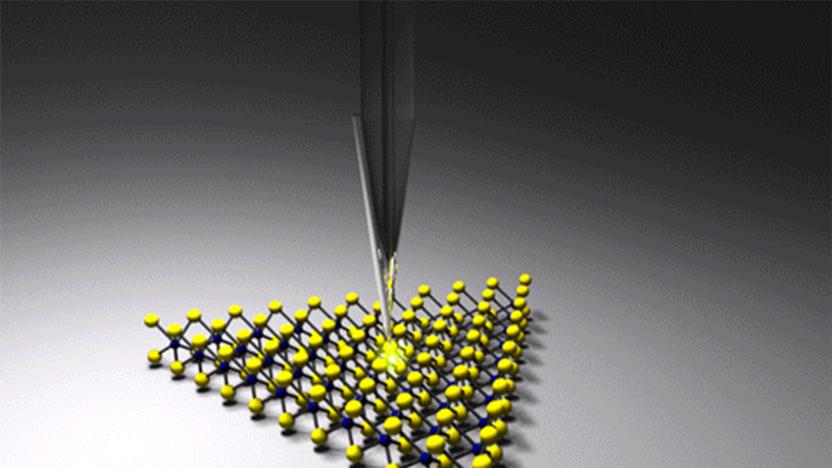
'Squeezed' light might produce breakthroughs in nano-sized electronics
A 'magic wand' squeezes light into a nano-sized point that could lead to breakthroughs in ultra-small devices.

Color-changing smart skin gets an upgrade thanks to chameleons
Color-changing smart skin is nothing new, but scientists have had a hard time working out the kinks. Current smart skin is fragile and buckles after being exposed to varying temperatures. To help remedy that problem, scientists turned to analyzing detailed videos of chameleons' skin. This helped them develop a far more resilient take on this tech, which shows a more promising future for color-changing gear.

Solar windows use sunlight to retain a building's heat
A domestic property loses as much as 20 percent of its heat through windows. For big glassy commercial buildings, that figure is a lot higher, resulting in big heating bills and inevitable disputes among employees about the thermostat. But researchers have now found a way to turn ordinary windows into solar-powered heaters, using energy from the sun to boost window temperature by as much as 15 degrees Fahrenheit.

Magic Leap is experimenting with light-bending nanomaterials
Mixed reality company Magic Leap is cagey with its tech, to say the least. However, it has released a research paper in conjunction with Berkeley Lab that hints on what it's doing. The team developed new materials that can take in light from more angles than before and redirect it with minimal losses. That could aid not only its mixed reality (MR) headset, which reportedly uses wave-guiding tech similar to the Hololens, but spark breakthroughs in holograms, invisibility cloaks and more.
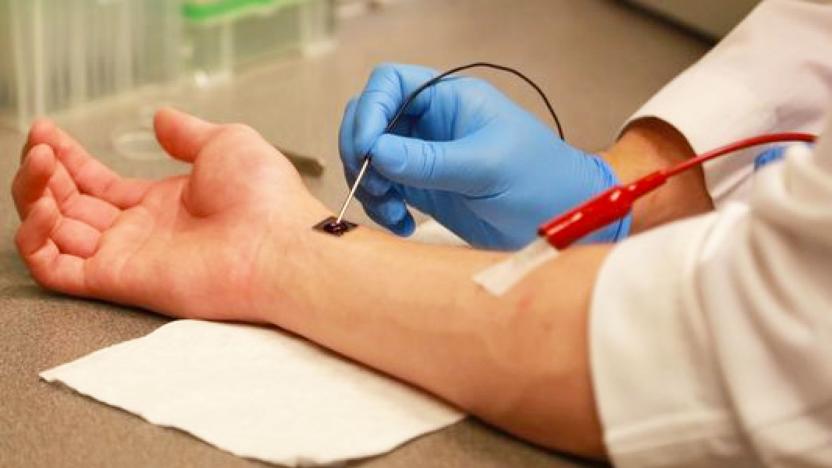
Fingernail-sized chip can repair damaged tissue in seconds
A new device can begin repairing damaged organs in seconds, heralding a major breakthrough for life-saving medicine. Developed at Ohio State University, the technology known as tissue nanotransfection (TNT) uses a small coin-sized silicon chip that "injects" genetic code into skin cells, converting them from one type to another.
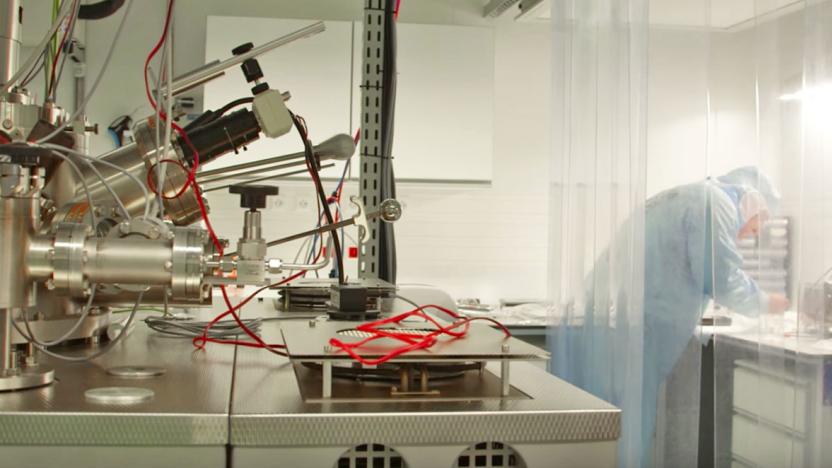
Prepare for the world's first nanocar race this month
Nanotechnology is fascinating, but for most people who aren't full-time chemists, it's a ridiculously dense field of study. An international team of scientists are trying to make nanotechnology more accessible to the public with the world's first nanocar race, scheduled to start on April 28th in the French city of Toulouse. Six teams hailing from three continents will gather at the Centre for Materials Elaboration and Structural Studies and attempt to jolt their custom nanocars across a polished gold track 100 nanometers in length (roughly one-thousandth the width of a human hair).

Smart bandages will use 5G data to track your health
Bandages are usually very mysterious -- it's hard to know how well you're healing until you unwrap them, and that usually means a trip to the doctor. If Welsh researchers succeed, however, you'll never have to wonder what's going on underneath all that cloth. Swansea University is planning trials (due within 12 months) of smart, 3D-printed bandages that will use 5G wireless data and nano-sized sensors to constantly relay details about your health. It would help physicians customize treatment based on the progress of your wound, your location and your activity. If you're healing well and are staying active, for example, you may get a different solution than someone who's recovering slowly and needs to stay home.
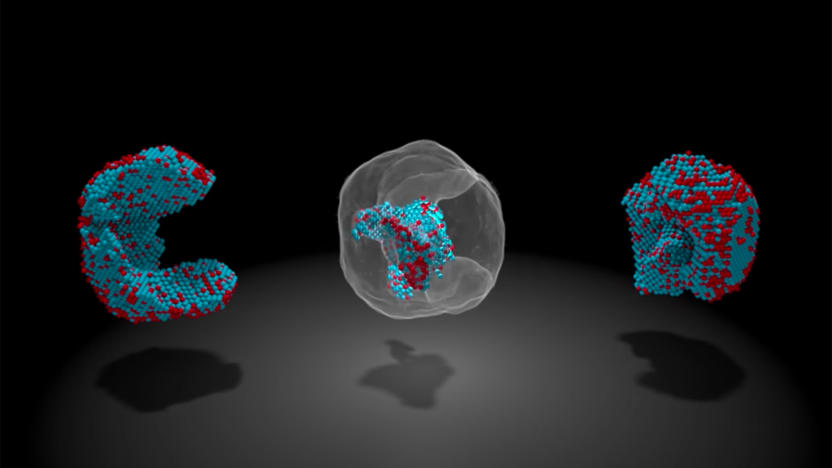
Scientists map every atom inside a nanoparticle
Even the smallest defects can create serious problems. It's a good thing, then, that researchers have found a way to map nanoparticles at an "unprecedented" level of detail -- they've located the 3D positions of all 23,000 atoms in an iron-platinum particle. The group used an extremely high-resolution transmission electron microscope (TEAM I) to capture 2D projections of the nanoparticle's structure, and used an algorithm to stitch those together into a 3D reconstruction. If there's a missing or misplaced atom, you could easily spot it.

Nanotechnology discovery could lead to low-power night vision
Night vision technology is essential on the modern battlefield but is not without its shortcomings. Conventional night vision goggles (NVGs) have been compared to looking "through toilet paper tubes" on account of their drastically diminished peripheral view. Even the top-of-the-line L-3 Ground Panoramic NGVs -- the ones used by US special forces during the Osama bin Laden raid -- are heavy, cumbersome and require an external power source. However, a breakthrough discovery out of the Australian National University could give us NGVs that are no thicker than a pair of normal sunglasses.

Nanomachines just won the Nobel Prize in Chemistry
If you want to know how far nanotechnology has come, you only need to ask the Royal Swedish Academy of Sciences. It just awarded the Nobel Prize in Chemistry to researchers Bernard Feringa, Jean-Pierre Sauvage and Sir J. Fraser Stoddart for their work on the "design and synthesis of molecular machines." All three have been instrumental to making nanomachines possible. Sauvage kicked things off in 1983, when he linked ring-shaped through a mechanical bond instead of the usual electron-sharing bond. Stoddart carried the torch when he slipped a moving molecular ring on to an axle in 1991, while Feringa built the first molecular motor in 1999.

Nano-scale mirror could be a breakthrough for optical computing
Using a mere 2,000 atoms of cesium, Professor Julien Laurat and his team at the Pierre and Marie Curie University in Paris have created the world's smallest mirror. According to postdoctoral fellow Neil Corzo, who is also lead author on the team's research paper published in the Physical Review Letters journal this week, the nano-mirror has the same level of reflectance as materials that require tens of millions of atoms and could one day lead to new advances in optical computing.

Invisibility 'cloak' hides objects by making them seem flat
Humanity is still some distance away from a real, honest-to-goodness invisibility cloak, but British scientists are that much closer to making it practical. They've developed a coating that uses graded refractive index nanocomposite materials (just rolls off the tongue, really) to reduce an object's electromagnetic signature. Ultimately, it makes curved surfaces seem flat -- electromagnetic waves leave almost as if there were no object at all.

Nano-sized diamond thread may be a super-strong wonder material
Move over, graphene -- you're not the only miracle material in town. Australian researchers have discovered that diamond nanothreads (one-dimensional diamond crystals capped with hydrogen) could be extremely strong. While scientists thought they were brittle when announced just a month ago, it turns out that they become supremely flexible (and thus durable) when you introduce the right kinds of defects. You could create nanoscopic structures that are just as strong as you need them to be, with a 'perfect' mix of bendy and rigid shapes.

Scientists build atom-scale sub that moves at 'breakneck' speeds
There are still no nanobots plying our bloodstreams, seeking and destroying cancer and other diseases. However, scientists at Rice University have just built a molecule-scale "submarine," so that's a pretty positive step towards "Fantastic Voyage." Mades at the same lab that developed "nanocars," the devices are a mere 244 atoms in size, with motors powered by ultraviolet light that turn at over a million RPM. That propels them along at a solid one inch per second, which is a "breakneck" pace according to lab director James Tour. "These are the fastest-moving molecules ever seen in solution," he said.

Nanowire technology will improve brain-stimulating implants
Scientists at Lund University have published a paper about a new nanowire thread (only 80 nanometres in diameter) that will work to strengthen brain implants. Neuro-prostheses are currently used to stimulate and collect information from the brain of those with Parkinson's disease, along with other illnesses. However, one of the biggest problems that current tech faces is that the brain identifies the implant as a foreign object and uses cellular material to surround the electrode, resulting in a loss of signal. With the newly developed technology, this will (hopefully) no longer be the case.

This tiny nanoscale wrench can tinker with molecules
This could be the tiniest, most adorable wrench you'll ever (not) see. A team of scientists lead by Severin Schneebeli at the University of Vermont has developed a nanoscale wrench that can control microscopic objects and will lead to making next-generation customized materials. It's just 1.7 nanometers in length and works by the power of molecular chirality: this is where two molecules are identical in composition, yet opposite -- like your left and right hands.

3D-printed DNA 'bunnies' could deliver drugs into your body
"DNA origami" is nothing new -- in fact, IBM once considered it as a way to make microchips. However, Scientists at the Karolinska Institute in Sweden have become ridiculously good at folding the building blocks of life, and built a bunny to prove it. The point was not to do a party trick, of course, though rabbit-shaped DNA is delightful. Rather, the team wanted to develop a fully-automated, 3D-printing-like method for folding DNA. Researchers could one day use the technique to create structures that don't break down in the human body in order to precisely deliver drugs.

Moore's Law in action: making our machines ever more micro
Over the past few decades, engineers have leveraged Moore's Law to the fullest, resulting in powerful ultrathin laptops and feature-rich miniature wearables. Back in 1981, a 23-pound Osborne 1 computer was considered portable, with 64KB of onboard memory. Today, smartphones weigh just a few ounces and easily pack 128GB of storage. There's also a vastly more complex architecture of circuits and sensors inside these devices, all at a scale nearly invisible to the eye. It's taken us decades to develop and shrink down these microelectronics to where they are today, which is no small feat. Join us as we ride the ever-shrinking gadget wave from its early days to some of the nanoscopic creations at work today.

Here's how 'flawless' materials break on a nanoscopic scale
Have you ever wondered why a supposedly defect-free material ends up cracking? University of Pennsylvania researchers have an answer. They've studied supposedly flawless materials (in this case, palladium nanowires) to see how they break on a nanoscopic level. As it turns out, these failures usually come down to atoms floating around when their bonds break, usually with little change in temperature. It's seemingly random, too, since the bonds vary widely from atom to atom. The scientists hope that identifying these weak points will help design devices that hold up under strain, even at the smallest possible level. Don't be surprised if you're one day using gadgets that are much more reliable, even at the smallest possible levels. [Image credit: VladKol/Shutterstock]

Nanotube-soaked spiders spin super-strong silk
Orb spider silk, already among the toughest and strongest materials found in nature, could soon get a super-strong nanoscale upgrade. A research team from the University of Trento, Italy recently sprayed 15 Orb-weaving spiders, members of the Pholcidae family, with carbon nanotube or graphene particle solutions. They found that doing so caused some of the spiders to spin even stronger silk than what they normally do. The team administered five spiders with a graphene-water solution and another 10 with a carbon-water mix. While some spiders subsequently spun sub-par silk (and four of them died outright), a few of the carbon-dosed arachnids actually produced strands 3.5 times stronger than the most resilient natural silk we know about.


