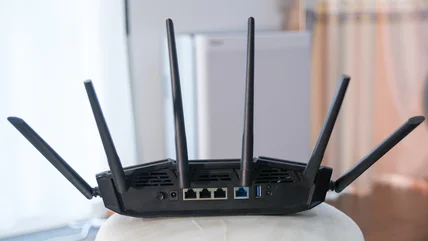
We knew the US military was looking to hook up space with a WLAN router, and lo and behold, WiFi has finally launched well above the stratosphere. According to a status log from the International Space Station over the weekend, the Joint Station LAN network was transitioned to "new Netgear wireless APs, which provide the ISS with WiFi connectivity." The official report details the crew using it for very official and politically correct things (you know, testing and whatnot), but we're pretty darn sure a deathmatch or two went down as well. Or maybe those guys we saw yesterday just had some sort of gravity hack going on...
While it doesn't appear to be nearly as serious as some of the computerproblems the International Space Station has faced, it looks like a virus has managed to find its way onto some of the laptops used on the Station, which NASA is now describing only as a "nuisance." According to SpaceRef.com, the virus is the W32.Gammima.AG worm, which is normally used to swipe sensitive information for online games. As Wired's Threat Level reports, the worm has also spread to more than one laptop on the Space Station, which would seem to suggest that it has either been spread via an on-board intranet, or via a thumb drive. Somewhat disconcertingly, when asked by Threat Level if any mission critical systems were connected to the same network as the laptops, NASA spokesperson Kelly Humphries simply said, "I don't know and even if I did, I wouldn't be able to tell you for IT security reasons."
We can't say we're terribly saddened that this riveting caper has finally ended -- after all, the poor crew needs a reliable place to unload, right? Shortly after the space shuttle Discovery delivered a new pump for the jury-rigged commode, Oleg Kononenko -- who we hear is now widely regarded as a galactic hero -- spent around two hours installing the hardware and running a trio of tests. After everything was tightened up and functioning as advertised, the crew presumably relieved themselves just before carrying on with the installation of the recently acquired Kibo lab. Crisis averted.
It's amazing how quickly humans can remedy problems when really placed in a bind, and rather than waiting for supplies to come up with Discovery next week, crew members aboard the International Space Station were able to solve their little dilemma already. Reportedly, cosmonauts were able to cure whatever was ailing the temporarily non-functioning john, enabling those stuck in space to urinate freely. Thankfully, the seven-year old toilet is due to be replaced with a fresh new one this Fall, and we'd say the replacement couldn't arrive soon enough.
You think it's bad when computers on the International Space Station get spazzed -- just imagine the chaos when the primary commode decides to stop functioning correctly. As of now, crew members are being forced to urinate in a "jury-rigged system" that's connected to the seven-year old (!!!) can, but thankfully, the solid waste collecting part has yet to act up. Still, we can imagine that folks on board are already fearing the worst. NASA officials have stated that they are currently mulling the idea of tossing a few parts on the Discovery just before it lifts off next week for a planned docking trip, which we can only hope pans out. Godspeed just took on a whole new meaning.
Apparently, the folks aboard Space Shuttle Endeavour aren't wasting any time piecing Dextre together (or jamming to their iPods), as just days after we first heard about this creature's future in space, now we're hearing that he's totally assembled and ready to rock. The bot, which is formally known as the Special Purpose Dextrous Manipulator, has been fitted with various tools and cameras and is all set to "undergo a series of tests and trials before it is asked to do major tasks." Godspeed, young Dextre -- hopefully you'll have more success than Ted and Gadget.
Apparently catering to the few folks out there that feel they have too few USB flash drives, Ultra Products recently let loose this so-called SpaceStation 6, which comes with no less than six tiny thumb drives that can be neatly concealed and used as the mood strikes. Of course, there's no hub action going on here -- which would be convenient -- and the slots likely won't play nice with your current stash of flash drives. If you're still interested, however, you can grab either a 12GB version (consisting of six 2GB drives) or a 6GB version (with six 1GB drives) right now for $90 or $60, respectively.
It may be not be the only bot on the block for long but, for now at least, the Canadian-built Dextre robot has the spotlight to itself, with it set to blast off Tuesday on board the shuttle Endeavor for delivery to its new home on the International Space Station. As USA Today reports, the robot has been some ten years in the making (at a cost of $210 million), and is designed to handle many of the tasks that would otherwise be done by astronauts on spacewalks. Those astronauts will still have a job for a while yet, with one of the main tasks during Endeavor's mission obviously being the assembly of Dextre, which is currently broken down into nine parts. Even after that's done, however, Dextre apparently won't start work until sometime in 2009, at which point it'll be able to replace nearly 140 parts on the ISS, and be controlled either by mission control or the crew on the space station.
It looks like Clarion is about to get some considerable new bragging rights (shared only by the likes of Tang), as some of its automotive A/V gear has recently been approved by NASA and is now awaiting deployment into space. That includes the company's RX935VD in-dash multimedia center and VCZ625 6-disc DVD changer, each of which have been fitted into a specially designed unit and will soon be used to entertain crew members on the International Space Station. As Clarion points out, that makes those the first car A/V components to be installed in the ISS, with their reliance 12 volt automotive systems (the same voltage as the space station) working largely in their favor. No word on an exact launch date just yet, but the gear is now ready and waiting in Star City for the next available spot to free up.
It looks like the space station's latest solar array is causing NASA yet more headaches, as a small tear was spotted by astronauts shortly after it was unfurled earlier today. The first of two solar arrays installed as part of this mission did unfurl without a hitch, but the second forced the astronauts to abruptly stop the deployment and inspect the damage, with a final verdict apparently still yet to be determined. This follows the discovery of some metal shavings in a motorized joint on Sunday, for which NASA already added a day to Discovery's mission in order to conduct a detailed inspection. As the AP points out, the space station needs all the juice from the new array it can get, with both the European Space Agency's soon-to-be-launched Columbus science lab and an upcoming Japanese lab dependent on it for power.
It's been a rocky few days in space, but it looks like the crashed Russian computers aboard the International Space Station are back up and running to spec, allowing the crew of Atlantis to depart tomorrow. There's still no word on what caused the computers -- which control vital life support systems, as well as the station's stabilizers and directional thrusters -- to fail, but the leading theory involves a surge from the new solar power array the shuttle astronauts installed. We're glad everything's okay -- but also we're totally curious as to what OS / processor combo they're running up there.
It looks like those Space Station computer problems are still causing headaches for NASA and Russia's Mission Control, as they're reportedly still not fully back up to speed after two days of repair work. According to the AP, the Russians worked on them through the night but only managed to get one of three power channels restored before the flight controllers told them to get some sleep. Despite the setback, NASA's still saying that the chances of abandoning the space station are remote, and that the crew are not in any immediate danger. In the meantime, the shuttle Atlantis's crew have apparently turned off cameras, laptops, and some lights to conserve power in case they need to stay an extra day to maintain the ISS's position.
It may have taken longer than expected, but the International Space Station is slowly starting to come up to full speed, with a new solar array now fully unfurled after being installed earlier during Atlantis' mission. Measuring 240 feet long, the twin solar panels are the third of four "wings" to be installed on the Space Station, which are required to provide the necessary power to the new modules set to be attached to the ISS later this year and next. Before they can be put into service, however, the astronauts have to retract part of an older solar array in order to make room for the new wings to rotate, which so far appears to be going off without a hitch.