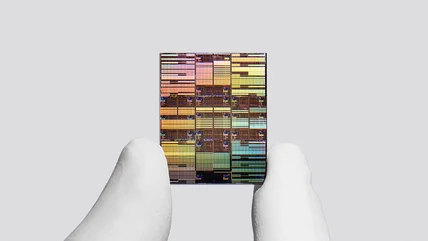
Stretchy silicon circuits wrap around complex shapes, like your wife
[Via BBC, thanks YoJIMbo]
Posts with tag silicon
IBM is looking to save around $1.5 million per year and be a kinder citizen to the environment by instituting a greener method for recycling silicon. Previously, IBM would sandblast defunct wafers to make sure no trade secrets left the premises when they were sold off to solar-panel outfits or used as "monitors." The new process, however, involves defacing the circuitry with an abrasive pad and water, which saves a few bills and leaves the silicon in much better shape for reuse. Reportedly, Big Blue has already implemented the new approach in its Essex Junction, Vermont facility, and the East Fishkill, New York plant is all set to follow suit shortly.
While some researchers over in Raleigh are having fun tinkering with PlayStation 3 farms and dodging the RIAA, NC State's Drs. Tushar Ghosh and John Muth are occupied building prototypes with fibers they say "resemble human muscle and can exhibit muscle-like capabilities when electrical currents are applied." The duo sees the development as paving the way for "advancements and potential applications in robotics, smart textiles, prosthetics, and biomedicines," as they have reportedly found that polyurethane and silicone tube structures shaped like human muscle strands can be manipulated with electricity. It was noted, however, that the current models are using strands "roughly the size of a pencil lead," but the next step is to scale down the fibers and integrate them into a robotic Mr. and Mrs. Wuf.
Proving that Malaysian industrial complexes aren't the only venues where shoddy security can facilitate the theft of thousands of PC components, a pair of crooks in California turned a minor fender bender into a successful heist of some 100,000 microchips on Tuesday afternoon. Police suspect that the men had been planning the crime for some time, as the victim's Fremont-bound Mazda MPV had just left a warehouse with $190,000 worth of chips when the robbers rear-ended it with their white van; rather than using weapons to subdue the driver, however, the two thieves simply waited until he exited the vehicle to discuss the accident, when one of them proceeded to slip into the minivan and drive away. The driver of the van followed suit, leaving the victim standing on the side of the road, no doubt confused and worried that his employer would chew him out for being so careless with the precious cargo. Although the brand of chip has not been revealed, since this all went down in Santa Clara, it's not too difficult to figure out whose products got pinched. So far authorities have no leads as to the whereabouts of the chips or the two robbers, but if someone in an MPV with license plate 4NKV115 tries to sell you a CPU for a buck and some change, do the right thing and notify law enforcement officials after you've purchased enough silicon to meet your needs. And if you're driving back home with your cheap booty when someone happens to ram your car, for heaven's sake, don't leave the keys in the ignition when you get out to exchange insurance info.
With Intel giving its shareholders some awfully great news to savor over the holidays, AMD had to hit back with some news of its own, but you'll definitely get a different vibe from reading ExtremeTech's take on the firm's recently showcased Barcelona than from the horse's own mouth. While AMD parades its 65nm chip as "the world's first native quad-core x86 server processor," and boasts about its "significant advancements in performance per watt capabilities," we've reason to wonder if things aren't a bit sugarcoated. While the wafer was demonstrated as utilizing "all 16 cores" and being a seamless upgrade from "dual-core to quad-core", hard facts (read: the much anticipated benchmarks) were curiously absent. Aside from injecting onlookers with more of the same technical minutiae we've seen over the past few months, AMD didn't exactly flesh out a lot of new details to chew on, but ExtremeTech's reference system "was the loudest they'd ever had in their office," and sucked down nearly 600 watts of power with just two HDDs and a single graphics card. So while we're firmly withholding judgment until its officially released, we'd say AMD still has a bit of tweaking to do before the competition rolls in.
For those out there just looking for zanier methods to get your illumination on, Group IV Semiconductor is hoping to deliver the goods you crave. While about 60 percent of the world's artificial lighting is still derived from the incredibly inefficient incandescent variety, companies like Philips are offering up LED alternatives that conserve energy, emit less heat, and convert perfectly normal buildings into nerdish eye candy. The Ottawa startup has spent its last four years researching and developing a silicon-based lighting system that will hopefully be "just as cheap" to produce as solid-state alternatives and emit equivalent amounts of light to boot. To overcome one of silicon's less helpful characteristics (poor light emission, of all things), the company has packed nanocrystals -- otherwise known as "quantum dots" -- between a transparent layer in which current is directed and a substrate of silicon underneath. Once electricity is applied, the nanocrystals settle back into their natural state, give off photons, and create a low-heat form of light roughly equivalent to a standard 100 watt light bulb. Group IV is aiming to produce a product that requires "90 percent" less energy than options currently on the market, while building it to last "50 times" longer than the already longevous alternatives, so you should probably expect this (presumably) once in a lifetime purchase to demand quite a premium should it actually hit store shelves.
In what's being marked as a breakthrough in the world of "photonics," Intel has managed to squeeze laser beam functionality into silicon-based chips, allowing for high speed data transfer between chips on the cheap. The new technology should be a boon to both high-end computer manufacturers and the fiber-optics industry, allowing for cheaper, smaller and faster optical switching of high volumes of data. Intel managed the feat by bonding some light-emitting indium phosphide to the surface of a regular ol' silicon chip that has been etched with light-directing channels. With billions of lasers in one place, the chips should help with the "last mile" problem of bringing fiber to the home, and resolve most bandwidth bottlenecks inside your computer -- though that type of consumer application could be quite a few years down the road. Commercial versions of the chips are still years away, but we're liking where this is headed.
Although you may have never given a thought to what transistors do to repair themselves when certain sectors fail, there are a few organizations who make it their life's work. Researchers from the National Science Foundation, the Semiconductor Research Corporation, and the University of Michigan have a mission to complete before their grant money runs dry: to create semiconductors that can heal themselves without the burdensome redundancy currently used. The goal here, which could seem a tad superfluous until you consider these chips operate in things like airplanes and medical devices -- you know, fairly critical applications -- is to design a semiconductor that runs more efficiently and can be counted on to function no matter how crucial the situation. By designing a chip that can auto-detect a problem, then shift the resources to a functioning area while the chip diagnoses and repairs the issue with help from "online collaboration software," you'll get a slimmer semiconductor that suffers no noticeable loss in performance while self-repairing. If this circuitry talk has your wires all crossed up, here's the skinny: more dependable chips will make everyone's life a bit easier, and if the team's plan is free of defects, we can expect to see prototypes within the next three years.
[Via Mobilemag]


Other Weblogs Inc. Network blogs you might be interested in: