magnet posts
Pardon the alliteration, but we're excited about the proposition here. For years -- millenniums, even -- scientists have been trying to figure out how to manipulate minuscule devices with magnets, and at long last, we've got a breakthrough in the field. Metin Sitti, an associate professor of mechanical engineering at Carnegie Mellon University, is credited with creating a new control technique that could allow microscopic machines to "one day deliver drugs directly to a sickly cell or a tumor." Essentially, the diminutive bots glide across a glass surface covered with a grid of metal electrodes, and you're just a click away (it's the Read link, just so you know) from seeing a live demonstration on how they can be used to "anchor one or more microbots while allowing others to continue to move freely around the surface." Good times.
Torrent's SureConnect HDMI cables stay put with magnets, blink with madness
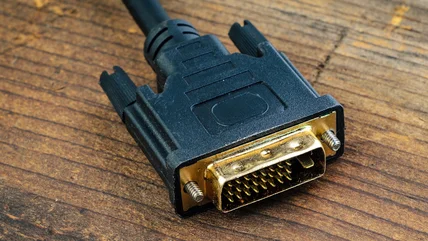
While we love the transmission capabilities of HDMI, we loath the fact that the HDMI standard doesn't specify a locking mechanism. If you've ever wall mounted a flat screen TV or tried to stuff your receiver into too tight a rack then you're probably familiar with HDMI's weak-azz connector. Now we have what appears to be a first of its kind, magnetic HDMI connector from Torrent, Inc. -- at least its the first to pass ATC compliance testing. Called MagLoc, the magnetic connector with sliding sleeve for optimal fit is said to be 5x stronger than your typical HDMI cable connector. Of course, anyone who's familiar with the magnetic "locks" on some laptop power cords can assure you that the technology is nowhere near as strong as mechanical fasteners. Still, it's a start.
Torrent's higher spec'd SureConnect Advanced and Elite cables also feature the totally over-the-top "VeriFYI" (ugh) indicator lights to confirm the end-to-end connection. VeriFYI blinks to confirm the HDMI cable you just inserted is in fact inserted -- something you should be able to confirm with the same pair of eyes looking at the jack. Insert the other side of the cable and VeriFYI will glow steady for one minute after testing the end-to-end connection. It then repeats this semi-useful (assuming your cables are easily visible) test each time you power up your system. While MagLoc sounds promising, it appears that the cables have yet to reach retail channels. We'll let you know as soon as that changes.
[Via The Inquirer and HDMI.org]
Torrent's higher spec'd SureConnect Advanced and Elite cables also feature the totally over-the-top "VeriFYI" (ugh) indicator lights to confirm the end-to-end connection. VeriFYI blinks to confirm the HDMI cable you just inserted is in fact inserted -- something you should be able to confirm with the same pair of eyes looking at the jack. Insert the other side of the cable and VeriFYI will glow steady for one minute after testing the end-to-end connection. It then repeats this semi-useful (assuming your cables are easily visible) test each time you power up your system. While MagLoc sounds promising, it appears that the cables have yet to reach retail channels. We'll let you know as soon as that changes.
[Via The Inquirer and HDMI.org]
AT&T's Samsung Magnet hands-on with video

Samsung's Magnet is inexpensive, orange, QWERTY, and we're really liking it. Sure, we don't have a price or an official date, but we we came away from our meeting with the Magnet feeling rather happy about the whole experience. Yeah, the web browser is a bit lightweight, and the color choice garish, but we can't find fault with that as it is aimed directly at a market that digs messaging and bright colors. The Magnet is comfortable to hold, the OS very responsive, and the screen ample bright and large enough to get the job done. The Keyboard, and the phone's size are very similar to a Nokia E71 (which we compare it to in the video for scale) so if you've checked one of those out, you'll know where we're coming from. A dash of 3G would add to the joy here, but then again, it would add to the price, too. Pics and videos are just after the break.
Update: Trimmed out background noise, or tried to.
LG Xenon, Neon join Samsung Magnet and Impression on AT&T
Outside of the smartphone realm, AT&T's really stepping up its game in the feature phone game, too -- so let's take this clockwise from the top left, shall we? First up, we have the brightly-colored Samsung Magnet, targeted squarely at the teen audience looking for serious texting power in a cheap package. Pricing hasn't been announced, but it should be easy on the wallet; it'll be available in the next few weeks. Next is the Impression -- also from Samsung -- which we'd previously known as the a877, the very first handset to officially launch on a US carrier with a full AMOLED up front. The screen's 3.2 inches of organic touchscreen awesomeness, accompanied by a 3 megapixel cam and a full HTML browser, all launching on April 7 for $199.99 on contract after rebate. Down below, we have the LG Neon -- a phone that's already launched up north on Rogers -- offering a full landscape QWERTY keyboard in addition to a touchscreen display for a low price, thanks in no small part to its lack of 3G data. The launch day hasn't been set for this one, but it'll come shortly. Finally, we have the long-rumored Xenon, featuring 3G, a 2 megapixel cam, QWERTY slide, GPS, and your choice of colors -- black, blue, or red -- all for $99.99 when it launches on April 8.
FielDrum magnetic drummer frees you from the tyranny of learning your instrument

You've heard the old saw "fake it 'til you make it," right? This is an instrument that takes those words to heart. Developed by the Magnetic Musical Training project, FielDrum sees a pretty standard percussion instrument fitted with a series of electromagnets. Placed beneath the drum head, the magnets can either be told to "attract" or "repel" via-MIDI, creating some kick-ass paradiddles as the new drum student holds his or her sticks over the instrument. Sure, this all sounds like fun, but this is the kind of research that could have serious ramifications: How do people learn things involving "complex physical gestures?" Can people "learn-by-feel?" How does this approach compare to traditional motor training? We're dying to find out the answers -- but mostly we're dying to get out hands on one of these drums for our robot marching band. Video after the break.
[Via Make]
[Via Make]
Magnetic 4-port USB hub: for brazen daredevils only
We know, the minuscule magnets adorned on this 4-port USB hub aren't technically strong enough to have any severe effect on your data, but seriously, why would you chance it? In what has to be one of the worst ideas in low-end technology to ever grace our eyes, the magnetic 4-port USB hub enables users to stick their hub on any nearby file cabinet, metal plate or refrigerator door, though we can't figure out why that's such an awesome benefit. If you can, however, feel to show off your carefree side by handing over $13.99.
DoCoMo and Fujitsu show off splitting phone at CEATEC
DoCoMo and Fujitsu are showing off some interesting phone tech in Japan at this year's CEATEC, particularly a concept device which can be split into two pieces. The gadget features a separate screen and keyboard segment, and the pieces can be configured in a standard flip-phone-like arrangement, or snapped together to form an X1 or Touch Pro-esque landscape QWERTY variation. The two halves are held together by magnets and communicate via Bluetooth. Of course, right now this is very much in the concept phase, and honestly -- aren't we trying to minimize the amount of electronic components we're carting around? Still, it's a fairly slick design, and certainly a new way of thinking about phones. Take another look after the break, and hit the read link for a slew of pics.
Researchers rework tongue-based communication
It turns out that the tongue isn't tied to the spinal cord (had we paid better attention in Bio101, we'd have known that), which goes a long way towards keeping it unimpared in the event of spinal cord injury. A team at Georgia Tech is developing a tongue-based apparatus for disabled people that, which not as elegantly packaged as the GRAViTONUS device we've seen earlier, fashions a pointing device from a small tongue-mounted magnet and sensors near the cheeks. The team has promised interactivity way beyond what can be done with "sip and puff" input methods; think "mouth replaces mouse" and you've got the idea. Hopefully Mavis Beacon tongue-typing and the incorporation of haptic feedback won't be far behind.
Embotec's levitating keyboard uses magnets, not forklifts

[Via AVING]
Researchers use magnetic fields to manipulate light
We've seen magnetics used in everything from closet improvements to insomnia treatments, but researchers at the University of Alberta and the United States Naval Research Laboratory have found that "by manipulating electron spin using magnetic fields, they can turn off and on light that's being guided through metals." By looking deeper into the fields of plasmonics and spintronics, the gurus have discovered that this on-off light switch could be used for tasks such as routing infrared light in optical communications or processing radio signals in cell phones. Additionally, this system could potentially decrease power requirements for the devices it invades, and while a finalized product isn't quite ready, the team is already anxious to "build devices that can act as switches in a chip."Intel patent app reveals flexible display fabrication plans
No sooner than a furry display patent application surfaces from Philips, it looks like Intel has jumped on the patent-a-random-display bandwagon along with Apple and a few others. Of course, flexible displays have long since been a figment of reality, but the "method of fabricating flexible displays" patent tends to focus more on the snazzy new development methods than the screen itself. Essentially, Intel is looking to use a duo of flexible sheets to sandwich a "number of magnetic display elements" that have "magnetically controllable reflectivity" between the two; furthermore the location of the magnetic particles "with respect to the flexible non-conductive sheets determines the reflectivity of the pixel." The presumably conductive boards would eventually be aiming at cellphones, "portable web browsers," and GPS navigation systems, but considering the head start that quite a few competitors already have, we hope Intel engineers are a bit past the drawing board on this one.
[Via UnwiredView]
[Via UnwiredView]
Magnetic clothes hangers rearrange your closet
As with most things that have remained fairly constant over the years, it was just a matter of time before someone with a tick of free time and a bright idea gave a new face to the clothes hanger. Daniel To's simply-named magnetic clothes hangers maintain the same forked design to gingerly hold your favorite threads, but rather than sporting a rotating hook, a magnetic cube was attached in order to give design-conscience homeowners a new way to assemble their closets. Of course, you'll need a metallic rack / roof to take advantage of the attractive (ahem) design, but we sure hope these end up coming in a heavy duty flavor for the more weighted aspects of our wardrobe.
[Via Freshome]
[Via Freshome]
Philips self-destructing MRAM on the way
Joining the ranks of quintessential kit that any spy (or CuteCircuit-equipped individual) should have on hand is Philips' self-destructing MRAM (magnetoresistive RAM). While securing data typically deals with some sort of password protection or biometrics, Philips' creation takes a page from the Mission: Impossible book by relying on magnetic loops remaining in flux to keep data accessible. Its MRAM chips are wrapped in two layers of soft, metallic foil -- one which is magnetized, and one that acts as a "keeper" by gathering flux from a permanent magnet and maintaining a closed loop surrounding the precious bytes. If a crazed data thief manages to crack open the enclosure and rip into the first layer of foil, all flux breaks loose and magnetic forces immediately raze any top secret files you may have been toting. If you just can't afford to spill those oh-so-privatized digital beans (or you simply enjoy that double agent lifestyle), keep an eye out for the presumably hush-hush release -- assuming, that is, this invention makes it from the patent stage into actual hardware.[Via New Scientist Tech]